#Renew the North for growth in every postcode

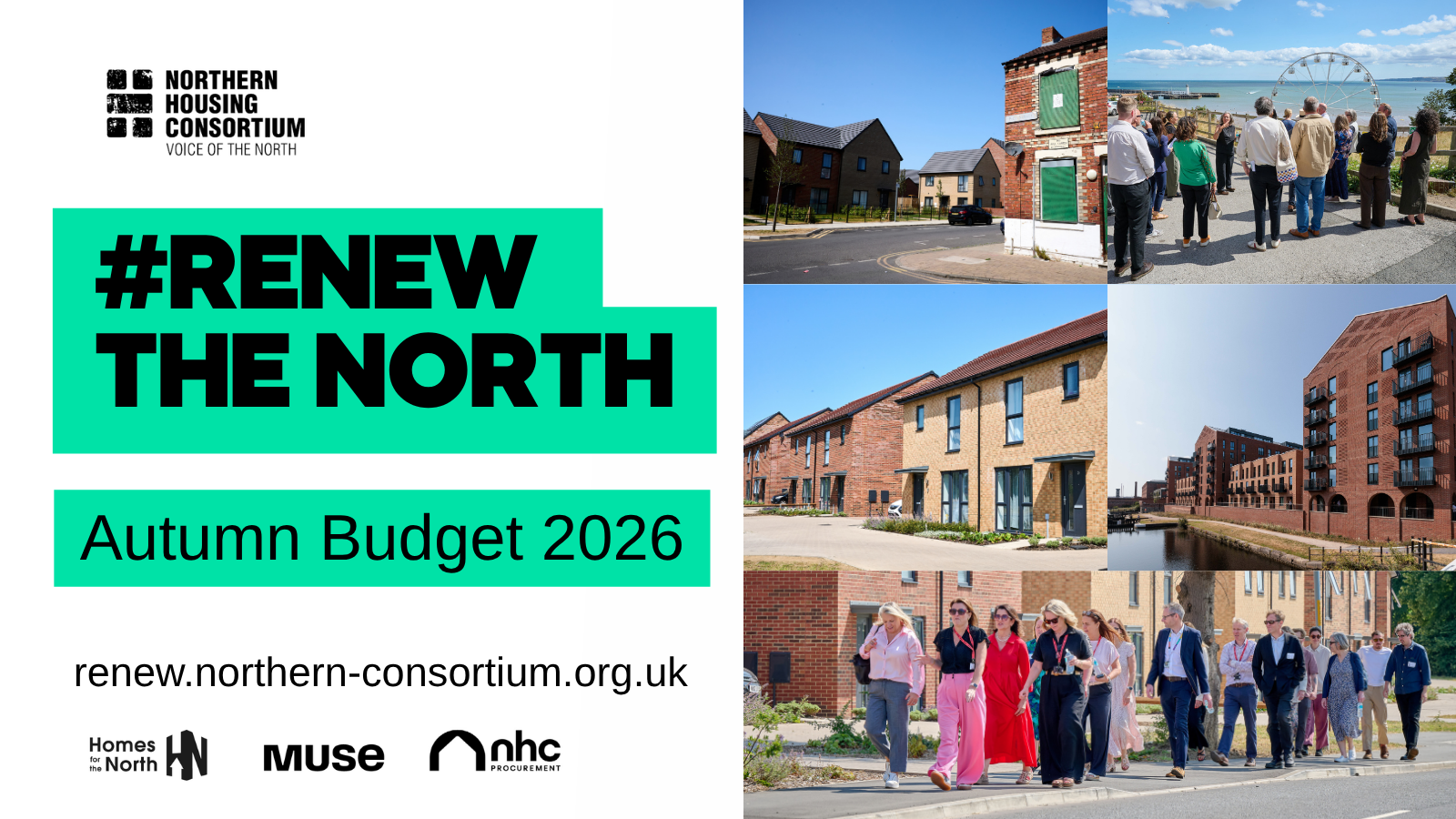
The Northern Consortium has submitted its representation ahead of the Autumn Budget and is urging the Chancellor to #Renew the North.  

The Government can support councils and housing associations to drive growth in every postcode and unlock at least 500,000 good quality homes across the North by:  

  • Adjusting and further devolving existing funding to better support regeneration  
    • Give Mayors and combined authorities greater flexibility to use the Social and Affordable Homes Programme (SAHP) for regeneration projects that meet local needs.  “Continuous Market Engagement” funding should not cap regeneration.  
    • Introduce Homes England performance measures focused on homes renewed and replaced, not just new homes delivered. Current indicators are heavily weighted towards new supply, limiting investment in regeneration projects across the North.  
    • Allocate National Housing Bank funding specifically for housing-led regeneration. This would help unlock schemes that are currently stalled by viability and funding challenges. 
    • Implement zero-rate VAT on building safety works and extend the zero-rating of energy-saving materials until 2030.This would maintain momentum in retrofitting, improving and regenerating older and colder homes. 
  • Establishing a new “Centre for Regeneration” in the North to build the capacity and capability needed to deliver regeneration at scale, while supporting Mayors with workforce development.  
  • Extending the term of the National Housing Delivery Fund to ten years, this will unlock all the North’s brownfield land and 320,000 new homes.   
  • Providing northern Mayors and combined authorities with devolved, place-based flexible funding of £500m per year alongside existing funding. Over ten years this investment would help transform the North’s 100,000 end-of-life social homes and enable Mayors to: 
    • Replace or refurbish end-of-life housing so residents can live in good quality social homes.    
    • Buy poor quality private homes, including empty homes, and turn them into safer and healthier social housing.  
    • Provide viability gap funding for strategically important regeneration schemes that deliver local benefits but are currently financially unviable. 

Chief Executive of the Northern Housing Consortium Tracy Harrison said:  

“The new Prime Minister has put housing, devolution and regeneration at the top of his agenda. Over the summer, I visited regeneration sites across the North and saw first-hand how housing-led regeneration is an essential part of driving growth in every postcode, making sure everyone has access to a good-quality home and creating thriving communities. However, despite the benefits, it remains challenging to deliver in the North. Lower land values and high remediation costs mean many regeneration schemes are simply not viable without Government support. 

“In our budget representation, we’ve set out changes the Government can make to unleash the potential of regeneration. Adjusting and further devolving existing funding to better support regeneration will have an immediate impact. Extending the National Housing Delivery Fund to ten years would unlock all the North’s brownfield land and 320,000 new homes.  

“To go further and make sure no one and nowhere is left behind, we are urging the Government to provide northern Mayors and combined authorities with devolved, place-based flexible funding of £500m per year alongside existing funding. Over ten years, this would transform the North’s 100,000 end-of-life social homes.

“Funding changes need to be underpinned by investment in capacity and capability. A new Centre for Regeneration would make sure regeneration can be delivered on the scale needed to drive growth in every postcode and transform communities in the North.” 

The Northern Housing Consortium is leading the Renew inquiry into housing-led regeneration for northern growth, supported by Homes for North and Muse. The Renew report found housing-led regeneration can unlock at least 500,000 good quality homes across the North of England. This includes reviving struggling high streets with over 100,000, new homes in town and city centres, building 320,000 homes on brownfield land and renewing or replacing 100,000 social homes in need of regeneration. 
 

Further information about Renew can be found here.  

Renew update

Over the past few months, the NHC has been continuing to press the case for regeneration in the North with the Government and building the political momentum around Renew – our inquiry into housing-led regeneration for northern growth – supported by Homes for the North and Muse. 

Our most recent work on Renew includes:  

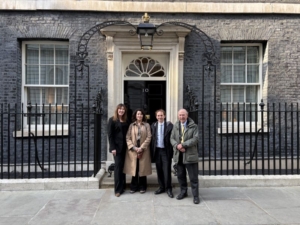
  • sharing our Renew report with northern MPs, ministers, Mayors, and other political stakeholders – including Andy Burnham MP and No.10 housing advisors.  
  • meeting with Tom Riordan, Northern Growth Envoy at HM Treasury. We’ve also met HM Treasury policy officials to discuss our Renew findings and understand their priorities.   
  • holding a policy roundtable with NHC members and Emma Payne, Director of Social Housing, MHCLG, and Selvin Brown, Director Net Zero Buildings, DESNZ, to explore the findings of our Renew report and discuss the real-world challenges and opportunities. 
  • discussed Renew at an MHCLG Social Housing Directorate away day, as part of the panel ‘Social Housing: Looking Ahead’. 
  • continuing to work with Lord Best OBE DL and Andrew Cooper MP, as Chairs of our Renew Inquiry and Westminster Group respectively. Lord Best OBE DL wrote an article for The House magazine (the magazine for parliamentarians) and Andrew Cooper MP wrote an article for Red Brick.  
  • Andrew Cooper also raised Renew in parliament during a Westminster Hall debate on estate regeneration. He highlighted our Inquiry and said that without significant intervention 100,000 social homes in the North could be lost over the coming decade. He also spoke about the far-reaching benefits of housing-led regeneration, and the need for regeneration to be delivered with communities. The overall tone of the debate was positive, with the need for good resident engagement a strong focus. It’s great to see how the rhetoric on regeneration is changing. The debate and a comment from the NHC was covered in Inside Housing.   
  • sharing our Renew findings and recommendations with key Labour Party figures at the Fabian Society’s Housing Summit in London, where Patrick Murray, Executive Director (Policy and External Relations) was on a panel with Martin McCluskey MP, now Minister for Local Energy and Jobs and Anna Dixon, MP for Shipley, along with social housing activist and author Kwajo Tweneboa.        
  • hosting a one-day Great North theatre on Renew at Housing 26 – with key contributions from Lord Best OBE DL, who set out how the continued focus on new homes was crowding out regeneration, but was optimistic the tide was turning. Martin Hilditch, Editor, Inside Housing, a whole host of brilliant NHC members, along with Sheffield resident, Lara Joyce, added to the packed agenda! The Great North Theatre showcased some of the fantastic work going on in the North. The message was clear – even more can be done with further support for housing-led regeneration and continued devolution.  
  • continuing to work with Inside Housing as part of their Spotlight on Regeneration series. Recent regeneration articles can be found on their website. We also worked with Red Brick on a series of articles on regeneration.   

The NHC team has also been developing resources to help you activate engagement with Renew with your local politicians. We will share these with members in the coming weeks and months to help build momentum to make this change happen. If you would like to take action now – get in touch with Saskia and we’ll work with you or your team, email – Saskia.neibig@northern-consortium.org.uk  

We will also discuss how you can help Renew as part of our joint Communications and Policy Network in September – you can view further details about the event and book your place at My NHC.  

Social and Affordable Homes Programme Statement August 2026

Welcoming the announcement of funding being released from the Social and Affordable Homes Programme, Patrick Murray, Executive Director (Policy and External Relations) at the Northern Housing Consortium said:

 “It’s great news for communities in the North almost £10bn of funding from the Social and Affordable Homes programme has now been announced outside London. Our members stand ready to build much-needed new homes, and we share the Government’s ambition for everyone to have a secure, affordable home which gives them the foundation for a good life. Allocating this funding now is the most important step to building more social housing in the next few years.

We also welcome increased collaboration between Homes England and Strategic Mayoral Authorities, with a bigger role for Mayors in the future, and the North’s housing partnerships will also be central to this. In the North, these relationships already have strong foundations and are proving to be a successful delivery model. This will mean we will be able to better respond to different housing challenges in different places and ultimately get more of the right homes built in the right places.

“However, the programme has been oversubscribed, which demonstrates the appetite for development and unfortunately means disappointment for some of our members who could build more much needed social homes with more funding. We also understand that the flexibility which allows the Social and Affordable Home Programme to be used for estate regeneration could be further utilised to unlock more delivery. There is a gap in funding for regeneration. Our Renew inquiry has found regeneration acts as a catalyst for new development and unlocks capacity to build more social housing, particularly in the North. Further investment in housing-led regeneration through a £500m per year, 10-year devolved regeneration fund is needed.

Nonetheless this is a good day for all those in need of an affordable home. This announcement will mean more social housing and housing associations and councils can finally get on with building.”

Tracy Harrison reflects on 20 years (and counting) of impact at the Northern Housing Consortium 

After two decades with the Northern Housing Consortium, Chief Executive Tracy Harrison reflects on what 20 years at the organisation has taught her, and her plans to take the NHC even further. 

Looking back over her time with the NHC, Tracy points first to the financial stability the organisation has achieved. A deliberate strategy to grow and diversify NHC Procurement has helped reduce reliance on other sources of income, protect the organisation’s surplus, and create new opportunities to support members. 

She is equally proud of the influence the NHC now has nationally. “Undoubtedly we are the voice of the North in housing,” Tracy says. “Increasingly, we have a seat at the table where we are the only regional housing voice.” 

A transformed sector 

Tracy joined the NHC in 2006, when the housing sector was part-way through the original Decent Homes programme. Providers were investing heavily in improving existing stock, while government attention was also focusing on the need for more homes. 

Nearly 20 years later, she sees clear parallels as the sector looks ahead to implementing a new Decent Homes Standard and renewed investment in existing homes. But the wider context has changed significantly following the global financial crash, austerity measures and the pandemic, while political change and fragmentation have created additional complexity for housing providers and for organisations seeking to influence policy. 

At the same time, tenant voice and customer focus have moved much closer to the centre of the sector’s thinking. For Tracy, whose early career was in fast-moving consumer goods, that focus on the customer has always been fundamental. 

Leadership shaped by people, purpose and enterprise 

Tracy describes her leadership approach as being shaped less by one defining moment and more by the environments she has worked in throughout her life. Growing up in a business family gave her a strong work ethic, a focus on adding value, and an entrepreneurial outlook. 

Early in her career, she also saw what a great team can achieve when people work hard, support each other and enjoy what they do. That belief in people has remained central to her leadership at the NHC. 

Making a difference in the North 

Although Tracy says she “completely fell into housing”, it is the people, purpose and impact of the sector that have kept her here. 

“What motivates me to stay in housing and at the NHC is working with really good people, having a fantastic working environment and a shared purpose – making a difference to people’s lives every day,” she says.

Initiatives with lasting impact 

Among the initiatives Tracy believes will have a lasting impact is the Unlocking Success Bursary. Launched in 2019, the Bursary, funded through the Northern Housing Consortium Charitable Trust, awards grants to tenants amongst NHC’s membership to support future employment. 

“The difference our Unlocking Success Bursary makes to people’s lives is clear every year at the celebration and fundraising event, and we can’t wait to see how that makes a greater and greater impact in the years to come,” says Tracy. 

Another major turning point came when Tracy became Chief Executive. Following the NHC’s first Member Perceptions Survey, the organisation made a conscious decision to become more targeted in our work. 

“That sharper focus has helped us to cement our influence where it can add most value for our members and gain traction with local and national government.
“More recently, the Renew inquiry into housing-led regeneration has built on years of work making the case that housing in the North faces unique challenges and requires solutions shaped by northern places. Renew has received evidence from organisations responsible for around one million of the North’s 1.4 million social homes and has set out how regeneration can unlock at least 500,000 good quality homes across the North.” 

Growing the NHC’s influence 

Tracy also highlights the long-term impact of investing in NHC Procurement. “An ‘invest to grow’ approach has enabled us to expand the team, strengthen processes and transform our procurement offer. Today, procurement is the major source of the NHC’s income and supports the wider policy, engagement and member offer.” 

She points too to the NHC’s Spending Review submission, which brought together a strong evidence base from work across the previous years. Tracy believes the submission played a major part in securing long-term investment for social and affordable homes, including the £39bn Affordable Homes Programme announced by Government. 

“The size and longevity of that funding programme is probably beyond what any of us imagined we would achieve,” she says. 

“Housing Partnerships have also become an increasingly important part of the NHC’s work, particularly as devolution gathers pace. Partnerships are proving themselves to be highly effective delivery bodies and will continue to be central to our work with members across the North.” 

Creating the conditions for people to thrive 

Asked what she hopes colleagues and partners would say has been her biggest contribution, Tracy returns to culture. 

“For us as an organisation, creating an environment where people can flourish and achieve their full potential – everything stems from that,” she says. 

Her approach has been to surround herself with talented people, give them space and opportunity, and create an organisation where people want to stay, contribute and do meaningful work. She says it is because of the NHC’s people that the organisation “punches well above its weight”. 

“That same commitment extends beyond us as an organisation,” she says through initiatives such as the Unlocking Success Bursary and the GEM programme, both of which support people to progress and develop careers in housing. 
Looking ahead 

For Tracy, the most enduring legacy of her time at the NHC so far will be the culture, financial sustainability, resilience, and of course the organisation’s growing influence on behalf of the North. 

“Financial resilience gives any organisation the option to do more, while culture is what enables talented people to deliver their best work,” she says. “Both have been essential to the NHC’s ability to build credibility, influence Government and support members.” 

As devolution continues to move up the national agenda, Tracy says the NHC’s focus now is on making the most of the moment. The organisation has helped create and support the architecture for delivery, including through Housing Partnerships, and will continue to champion the role of housing in northern growth. 

“My ambition hasn’t diminished at all,” Tracy says. “My drive for the organisation is still there, and the sky is the limit for us at the NHC. It’s so clear that we are making a real difference, and it still feels like there’s so much more we can do.” 

She also wants to keep building the NHC’s culture as work patterns continue to change – positioning the organisation both as a place where people can build long-term careers and as a talent incubator for the wider sector. 

Tracy also pays tribute to the NHC Board, describing them as extremely supportive and committed, and central to what the organisation can achieve. 

“The more we do great work, the more great people want to work with us – whether as colleagues, partners or members,” she says. 

“Let’s Keep Leading”: Housing Partnerships Come Together to Shape the North’s Future 

View imageIn the week where Andy Burnham MP made his first major leadership speech at the People’s History Museum in Manchester, housing partnerships from across the North came together for the NHC’s first Housing Partnerships Northern Conference to share learning and demonstrate how partnership working is delivering at scale. 

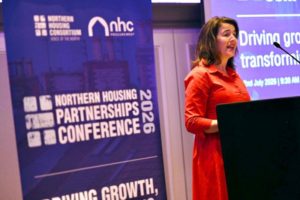
On Thursday 2nd July, NHC Chief Executive, Tracy Harrison opened the conference, setting out the progress made by partnerships, highlighting that they are now an established part of the housing system. She emphasised the importance of the role of housing partnerships in delivering regeneration and devolution across their regions. 

In her key remarks she highlighted how housing partnerships have involved from an innovative concept to a vital mechanism to help us move faster, align investment, solve problems collectively and ensure housing has a stronger voice in wider discussions around growth, health, skills, transport, net zero and regeneration. Tracy also emphasised the North has led the way in developing housing partnerships, noting that housing partnerships are increasingly being viewed as an example of effective collaboration by organisations and regions outside the North. 

She reflected: “At the Northern Housing Consortium, we’re proud champions of devolution because decisions are almost always better when they’re made by people who know their places, understand their communities and have real skin in the game…  

Housing Partnerships are a practical way of getting things done.  

View image

They help us move faster, align investment, solve problems collectively and make sure housing has a stronger voice in wider conversations about growth, health, skills, transport, net zero and regeneration.” (full speech can be found here) 

Devolution was a consistent focus throughout the conference. Speakers highlighted the importance of a housing-led, place-based approach, aligning housing with infrastructure, transport and wider priorities to maximise funding. Strong governance and integrated settlements were identified as key to making this work in practice.  

Homes England reinforced the role of housing partnerships in delivery, highlighting their importance in building pipelines of new homes and supporting strategic place partnerships.  

Sessions also explored the role of local authorities within partnerships, including the challenges of balancing responsibilities as landlords and place-shapers. Partnerships were identified as a mechanism for coordinating activity across areas and enabling a more strategic approach to place.  

Workshops focused on delivery. In the North East, partners are already seeing the benefits of joint procurement, including cost savings, more efficient use of funding and the creation of local employment opportunities. Delegates identified leadership alignment, shared values and executive buy-in as critical to successful collaboration.  

Attendees also reflected on how to strengthen influence locally. Aligning with mayoral priorities and demonstrating delivery were seen as essential to building trust, with partnerships using their scale and collective voice to engage effectively.  

Skills and workforce pressures were a key issue, with significant vacancies across the construction sector. Partnerships are working with colleges and training providers to develop targeted pathways into employment, including new training academies and collaboration with further education.  

A key theme that came out strongly throughout the day was the importance of housing-led-regeneration and the work of the Renew inquiry as a strong example of what housing partnerships can achieve collectively. Referencing the inquiry in her key note speech, Tracy highlighted how the inquiry received evidence and insights from organisations responsible for around 1 million of the North’s 1.4 million social homes and more than 160 individual regeneration schemes and sites. The strength of this evidence coming from the willingness of housing partnerships, members and partners across the North to contribute their knowledge, expertise and experience. View image

The Renew report found that housing-led regeneration can unlock at least 500,000 good quality homes across the North of England, and is based on the evidence of  

The conference also highlighted the wider role of housing partnerships, including supporting health, preventing homelessness and working with communities. Examples included integrating housing into health systems, scaling up homelessness prevention approaches and responding to local challenges through long-term community engagement.  

Overall, the Housing Partnerships Northern Conference demonstrated the growing role of partnerships in coordinating delivery, influencing policy and responding collectively to shared challenges across the North. 

Tracy challenged delegates to continue building on the progress made so far:  

“The North has led the way so far. My challenge to all of us is simple. Let’s keep leading.” 

Cabinet appointments provide continuity for NHC members  

The new Prime Minister Andy Burnham MP has made several key cabinet appointments which will have a significant influence on social housing in the North. These include:  

  • John Healey MP – Chancellor of the Exchequer, and MP for Rawmarsh and Conisbrough in South Yorkshire. Former Housing Minister, Treasury Minister and Shadow Housing Secretary.  
  • Angela Rayner MP – Secretary of State for Housing, Communities and Local Government and MP for Ashton-under-Lyne in Great Manchester. Former Secretary of State for Ministry of Housing, Communities and Local Government.  
  • Matthew Pennycook MP – Minister of State for Housing and Planning  and MP for Greenwich and Woolwich  in London, he now attends cabinet. Housing Minister since 2024 and Shadow Housing Minister December 2021 – July 2024.  
  • Miatta Fahnbulleh MP – Secretary of State for Energy Security and Net Zero and MP for Peckham in London.  Former Department for Energy security and Net Zero Minister and Parliamentary Under-Secretary of State for Devolution, Faith and Communities.  

Northern Housing Consortium Chief Executive Tracy Harrison said: 

“The North needs stability and certainty to tackle the scale of the housing challenge—and these appointments provide that. Each Minister brings recent, hands-on experience of working with the sector, alongside a clear understanding of the North, regeneration, and the power of devolution. We particularly welcome the news that Matthew Pennycook MP will now attend Cabinet, giving housing the stronger voice it needs at the top table. We look forward to continuing to work with the new Ministers to make sure more people in the North have access to a good quality, affordable home in place they’re proud of.” 

NHC looks forward to working with new Prime Minister to ‘give hope for forgotten places’  

Andy Burham MP was today appointed as Prime Minister, the seventh Prime Minister in ten years.  

Mr Burham has promised to ‘do things differently’ and to take a more collaborative approach to politics. He has pledged to launch a new 10-year plan for Britian later this year, though he was keen to stress he will also make changes from the start, including ending rough sleeping and building more council houses.  

During his leadership campaign, he reiterated his support for devolution and spoke about the importance of regeneration.  

Northern Housing Consortium Chief Executive Tracy Harrison said:  

“We look forward to working with the new Prime Minister to give hope back to forgotten places. A good quality, affordable home is one of life’s essentials. Our Renew inquiry has found that housing-led regeneration can unlock at least 500,000 good quality homes across the North of England. It can bring hope by making sure more people have a great place to live, improving and residents’ health and wellbeing, and generating jobs. Housing-led regeneration – reviving struggling high streets with new homes, developing forgotten brownfield land, and renewing and redeveloping homes that no longer meet the needs of communities – can help bring growth to every postcode.  

“The new Prime Minister has acknowledged the importance of regeneration, so we hope he will seize the moment to build on investment that the Government has already made in housing, with long-term devolved regeneration funding, and support to build local capacity and expertise. Our policy recommendations are about ensuring that regeneration is viable and achievable across the North, which has diverse needs and challenges beyond our cities. As Lara Joyce, Secretary of Gleadless Resident’s Association said, we need “to make it safe to feel hope again”. 

“Andy Burnham is a big backer of devolution, and we know he wants to build on the success we have already seen in the North. In areas where devolution has progressed further, social housing providers and other partners have collaborated and have had real success scaling up what works for communities so more people and places benefit.”  

Many of our members in Greater Manchester have worked closely with Andy Burham during his time as Mayor. Northern Housing Consortium Chair, Chief Executive of MSV Housing, and Chair of Greater Manchester Housing Providers Charlie Norman said:

“It has been great working with Andy Burham in Greater Manchester for the last 9 years, collaborating on a place first and housing first agenda, with people at its heart.” 


NHC reaction to Andy Burnham MP’s speech

The Northern Housing Consortium (NHC) has today welcomed Andy Burnham’s focus on greater devolution of powers to places, and his statement that regeneration will be one of No10 North’s three priority areas. He stressed that everything starts with a good home, and the country needs to put that at the top of its priority list.

Andy Burnham’s call for greater devolution and a focus on housing and regeneration reflects recommendations made by the NHC’s current Renew inquiry into housing-led regeneration and how it can deliver growth, help tackle the housing crisis, and strengthen communities across the North.

Research published by the NHC through its inquiry earlier this month showed that housing-led regeneration can unlock at least 500,000 good-quality homes across the North. This includes more than 100,000 new homes in town and city centres, 320,000 homes on brownfield land and the renewal or replacement of 100,000 social homes in need of regeneration.

The Renew inquiry draws on evidence from organisations responsible for around one million of the North’s 1.4 million social homes and insights from more than 160 regeneration schemes.

Tracy Harrison, Chief Executive, NHC, said

“We welcome this renewed focus on regeneration and putting power back into the hands of people and places. In fact, it’s like he’s read our recent Renew Inquiry report and acted on it!

Giving the proposed No.10 North the power to focus on regeneration could be game changing for local communities. It’s great to see the importance of a good quality home as a foundation of a good life so clearly recognised. Our extensive research with housing providers in the North through the Renew Inquiry shows that housing-led regeneration is essential to increase the supply of new homes, attract private investment, and boost economic growth across our northern regions. It helps create great places to live, improves housing quality and residents’ health and wellbeing, generates jobs and skills opportunities, and promotes sustainability by providing greener, more energy-efficient homes that lower household bills.”

“The North’s towns and cities have different strengths, challenges and ambitions. People who know these places best are local leaders, working alongside residents, housing providers and businesses. More power must be devolved to them. It was great to hear the importance of collaboration to drive change, something that is happening across the North’s housing partnerships.”

These themes will be a key focus of the NHC’s Housing Partnerships Northern Conference on 2nd July in Leeds, which will bring together housing partnerships, Mayoral Strategic Authorities and key local stakeholders together to share learning and shape future policy.

Leading the way with regeneration, devolution and partnership working – the Great North Theatre 26

The far-reaching role of housing-led regeneration, and the Renew inquiry, and partnership working have been big talking points at the Great Northern Theatre 26.
The importance of housing-led regeneration shone through in the morning. The day opened with a speech from Lord Best who set out how the continued focus on new homes was crowding out regeneration, despite a clear need. However, he was optimistic that the tide was turning, and the Renew inquiry, which he chairs, is a big part of this.

Next up was Patrick Murray, NHC Executive Director (Policy and External Relations) who shared the latest findings from Renew inquiry report ‘Unlocking over 500,000 good quality homes in the North’. He highlighted how housing-led regen is critical to driving growth, and invaluable in making sure smaller towns and places are not left behind. He talked about devolution and how we are already seeing benefits of a more place-based approach. However, he said there is a structural viability gap in the North and this can only be overcome with the right government support.

The next session, chaired by Inside Housing Editor Martin Hillditch, featured a range of perspectives on why regeneration at scale is important. Rachel Dennis Chief Executive, Incommunities said it was vital to address the full picture.  In Bradford, where Incommunities is based, estate regeneration needs greater support to avoid ‘a doughnut of deprivation’ around the city centre. John Johnson Chief Executive, Bernicia Group talked about devolution being a potential gamechanger, but that central government needed to fully trust devolved authorities. Lara Joyce Secretary of the Gleadless Valley Resident Association shared how regeneration gives residents hope but that promises must be kept to avoid breaking residents’ trust. Finally, Phil Mayall Managing Director of Muse talked about why homes are an essential part of creating places people can thrive. However, he said viability challenges and the skills gap were holding things back.

The final session of the morning, chaired by Claire Warren, Chief Executive, Pickering and Ferens Homes covered community-led renewal. The panellists Cedric Boston, Group Chief Executive, Unity Homes and Enterprise, Louise Davies, Executive Director of Communities and Regeneration, Cobalt Housing, Darren Sterling, Assistant Director Strategy and Community Regeneration, Newcastle City Council  and Kemoy Walker, youth ambassador at  MSV Housing, were all clear that to really understand what residents want housing providers need to embed themselves in communities. Housing colleagues should go to where the residents are, for example youth clubs or community events.

In the afternoon the focus shifted onto devolution and partnership working. To avoid a post-lunch slump proceedings started with an illuminating conversion between Inside Housing Martin Hilditch and designer Wayne Hemmingway, who famously spoke out against the ‘Wimpyfication of Britain’. The chat covered housing design, the effects of high land values and the role of culture in driving regeneration.

Up next was a panel session about ‘Integrated settlements: Building connected systems for long-term growth’, chaired by Tracy Harrsion, with Ruth Davison Interim Director of Environment and Place, West Yorkshire Combined Authority, Ed Ferrari, Research Director, Mosidi, and Tom Hinchcliffe Director of Housing First, Greater Manchester Combined Authority. The panel agreed that we’ve come a long way with devolution, and that integrated settlements are helping deliver a more joined up approach to places. Importantly the discussion focused on the democratic mandate of Mayors and how more accountability should flow to local communities rather than central Government.

This was followed by a panel session on effective partnerships chaired by NHC Deputy Chief Executive James Ealey. Marc Edwards, Executive Director of Property at Gentoo, spoke about the North East Housing Partnership’s collaborative planned investment partnership which is helping North East housing providers save millions on the installation of new kitchens and create local employment opportunities. Shazia Bashir, Partner, Winckworth Sherwood, shared insights on partnerships from a legal perspective. Robin Tuddenham, Chief Executive, Calderdale Council, spoke about the need for local authorities to step forward and take a leading role in partnerships, and to get the balance right between structure and collaboration. Sasha Deepwell, Chief Executive, Irwell Valley Homes shared her experience of being part of Greater Manchester Housing Providers, the longest established housing partnership, and the huge impact it is having.

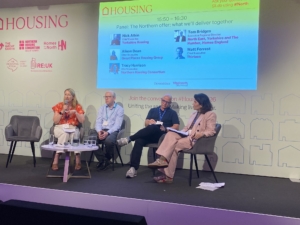
The afternoon was rounded off with a positive discussion, chaired by Tracy Harrison, about the northern offer and what we’ll deliver together. Nick Atkin, Yorkshire Housing Chief Executive, stressed that the social housing sector has a once a generation opportunity to make a difference and that we’re ready to step up. Tom Bridges Executive Regional Director (North East, Yorkshire & Humber), Homes England spoke about Homes England’s increased focus on placemaking and the opportunities available through the Social and Affordable Homes Programme and the National Housing Bank. Alison Dean Chief Executive Officer, Great Places felt optimistic, sharing examples of work happening in Greater Manchester and South Yorkshire, including bringing disused brownfield land back into use and renewing estates to make sure everyone has access to a good home.

The Great North Theatre showcased some of the fantastic work going on in the North. The message was clear – even more can be done with further support for housing-led regeneration and continued devolution.


Regeneration making a difference in Halifax  

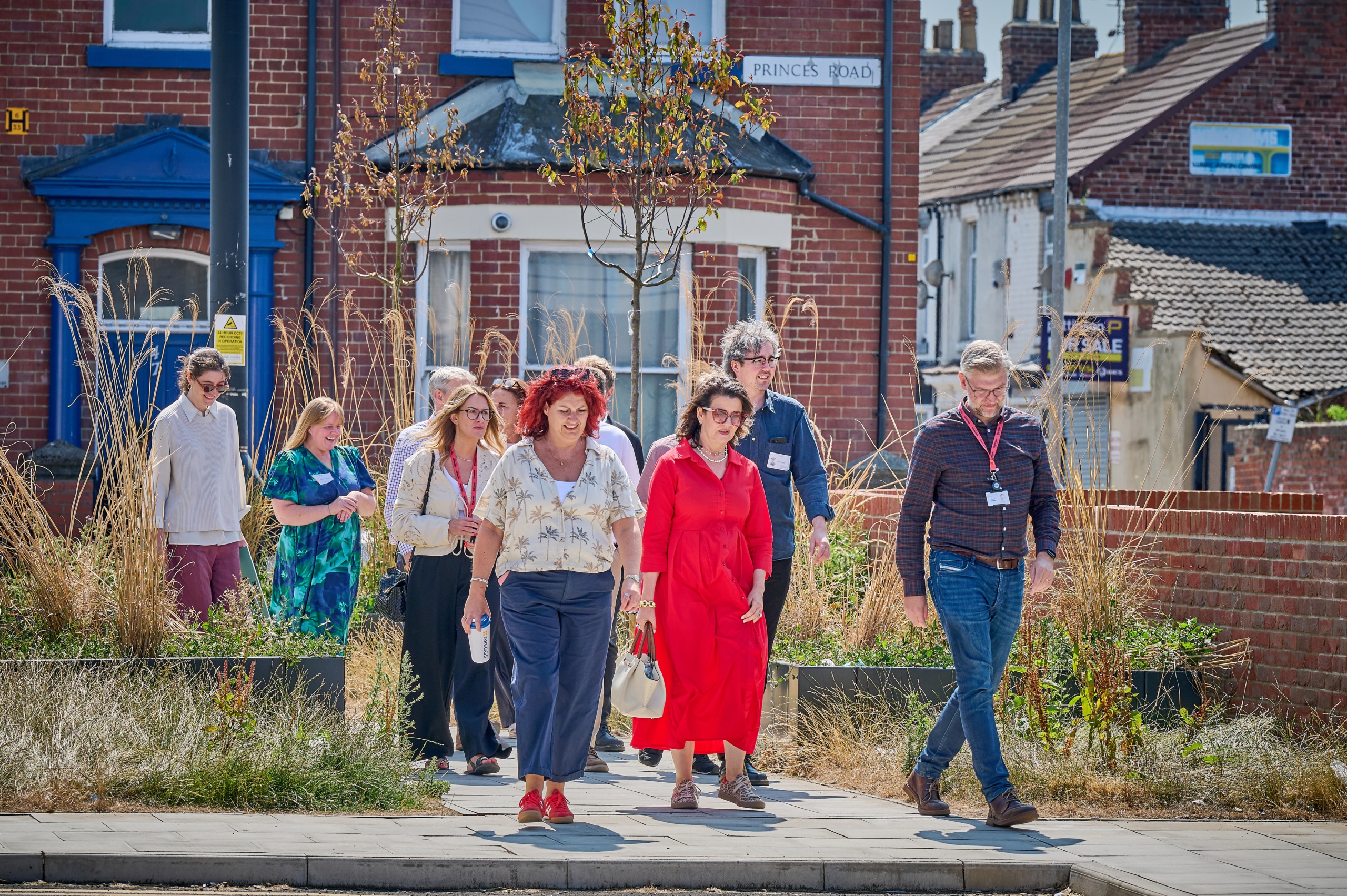
The Renew inquiry visited regeneration sites in Halifax to see what can be achieved and where even more can be done. Calderdale Council and Together Housing Group, who have been part of an investment partnership since 2017, hosted the visit.

The first stop on the tour was Boltworks where 122 new Build to Rent flats were built on a disused car park by Placefirst. Viability challenges were overcome through funding, including money from the Brownfield Housing Fund, to deliver good quality homes. This development, which completed in 2025, meets the need for smaller properties in the City ward due to a high proportion of single person households.

Next stop was the award-winning Beech Hill Regeneration project where 106 new affordable homes replaced three tower blocks which no longer met modern standards. In phase two, 70 mixed-tenure homes in the surrounding area were repaired and made more energy efficient. This reinvigorated the area which was becoming neglected and isolated.

After that we walked through the impressive Dean Clough, a former carpet mill that’s now a hotel, gallery, shops, restaurants and offices up to Haley Hill, a trio of 1960s tower blocks.  These homes will benefit from Together Housing’s investment and retrofit work to ensure they remain modern, safe places to live. 

Tower blocks were a hot topic of conversation. Together Housing spoke about their high-rise strategy and how they balance “immediate safety and compliance requirements with long-term investment decisions that deliver modern, sustainable homes and support thriving communities.”

The final stop of the tour was Minster View – a brownfield site which recently went out to market. It is hoped development of the land will contribute to town centre regeneration objectives as well as enhancing the local economy. The tour was rounded of by walking back through the regenerated Borough Market.

Earlier in the day the Renew Reference Group, a group of NHC members coming together to share insight on regeneration, met for a roundtable discussion about the latest findings from Renew, high rise development and the ten-year vision for Halifax. 

The Renew inquiry will visit more regeneration sites over the summer to document what works well and where more needs to be done. Renew is supported by Homes for the North and Muse.