
Northern Housing Summit 2026: Leading Change, Delivering in Place.
Hot on the heels of the Autumn Budget, the Northern Housing Summit brought together leaders from across housing, local and national government to explore what is needed to deliver better homes and places across the North.
Chaired by broadcaster and columnist Sonia Sodha, the Summit explored some of the biggest issues facing the North, from housing-led regeneration and new supply to devolution, regulation, technology and the relationship between local and central government.
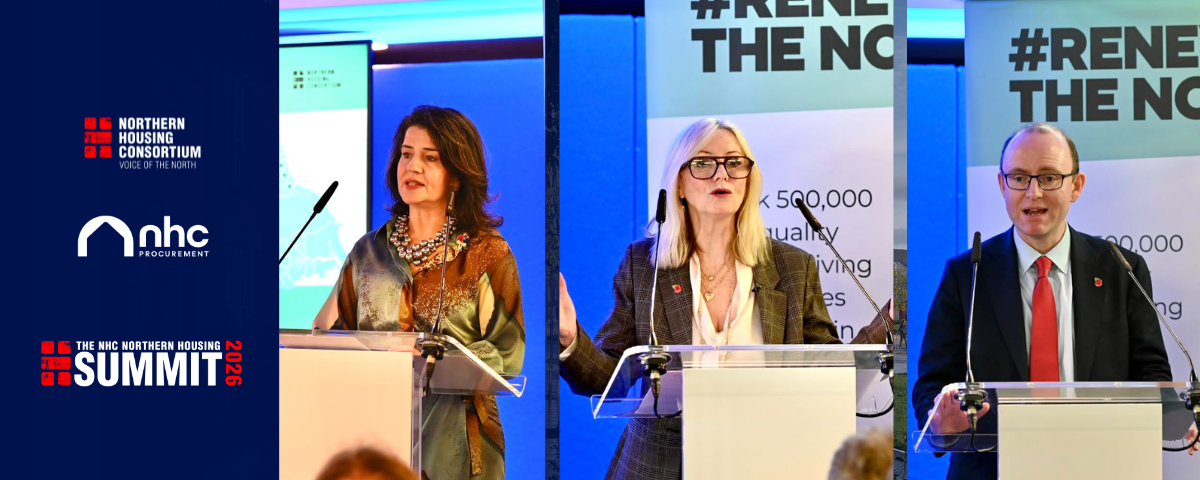
Opening the event, NHC Chief Executive Tracy Harrison reflected on both the opportunities and challenges facing the sector and what the Autumn Budget could mean for the North.
The NHC welcomed the Budget’s focus on devolution and new funding for Mayors and the sector. This included £285m of Good Growth Funding for mayors and local leaders, £150m of capacity funding for Mayoral Strategic Authorities and a further £1.5bn for affordable housing. Tracy also welcomed confirmation of reforms to the Green Book, an issue the NHC has campaigned on over a number of years.
“As the Chancellor said, housing is at the heart of this,” Tracy said. “Our job is to keep the North’s housing needs firmly on the agenda, and we’ll keep doing that in the run-up to the Spending Review.”
Her message was that the NHC will continue to make the case for housing-led regeneration, supporting further devolution and ensuring councils and housing associations can both play their part in tackling the housing crisis.
Devolution: an opportunity to be ambitious
Tracy Brabin, Mayor of West Yorkshire, reflected on her own experience of growing up in council housing and spoke about the vital role social housing can play as a foundation for a fulfilling life.
She described the opportunities presented by devolution as “revolutionary”, encouraging the North to be ambitious, innovative and creative. She urged places to focus not on what they are allowed to do, but what they want and need to achieve, ensuring support reaches those who need it most.
With power moving out of Westminster, her message was that policy should increasingly be delivered with places, not to them.
Drawing on the NHC’s Renew inquiry, she highlighted the potential for housing-led regeneration to unlock at least 500,000 homes across the North with the right support.
Regeneration: putting residents and places at the heart of delivery
The future of housing-led regeneration was a major theme throughout the day.
Our panel on ‘Where next for regeneration in the North?’ brought together Patrick Murray, Executive Director of Policy and External Relations, NHC, Bethan McCaw, Deputy Director – Good Growth Fund, Greater Manchester Combined Authority, Emma Payne, Director – Social Housing MHCLG, Ben Hanson, Assistant Director of Housing Services, Hull City Council and Ralph Rudden, a Sale West resident, Chair of Amazing Communities Together and Co-Chair of Our Sale West.
There was optimism about the opportunity to make progress, particularly through greater devolution, alongside recognition that further dedicated regeneration funding would enable the sector to go further and faster.
But it was the importance of residents in successful regeneration that came through most strongly.
Reflecting on the NHC’s Renew tours, Patrick Murray spoke about the inspirational people working tirelessly to improve their neighbourhoods and create better opportunities for their families. He highlighted the stories of residents he had met through the inquiry, including Lara Joyce from Sheffield, who wanted children on her estate to feel there was something for them in their city. “Ultimately, it is communities that will make regeneration happen,” he said.
Ralph Rudden reinforced the importance of genuinely listening to residents, warning that “there is little point having an open-door policy if minds are closed.”
Emma Payne also reflected on the value of the Renew inquiry and site visits in building the evidence base for regeneration and bringing the challenges and opportunities to life. The discussion highlighted how closely housing and regeneration align with the ambition to drive growth in every postcode and how critical regeneration is to deliver that growth.
The discussion also demonstrated the opportunities created by taking decisions closer to communities. Bethan McCaw highlighted how Greater Manchester Combined Authority is bringing different funding streams together through its Good Growth Fund, enabling the authority to respond more effectively to the needs of places.
To continue building evidence, we launched the Northern Regeneration Map at the Summit, sharing practical examples and learning from regeneration projects across the North. Our next phase of Renew research will explore residents’ experiences of regeneration and how partners can work better together.
Turning ambition into delivery
Delivering good-quality existing homes, serving communities and building new homes while navigating significant financial pressures was another central theme.
Jonathan Walters, Chief Executive, Regulator of Social Housing, Dave Brigden, Senior Commercial Director, The Housing Finance Corporation, Louise Bassett, Chief Executive, Gentoo and Matt Sugden, Chief Executive, Railway Housing Association, explored the choices facing housing providers. Jonathan emphasised the need for an evidence-led and accountable regulatory framework and for providers to communicate clearly about the difficult choices and trade-offs they face.
Turning big delivery challenges into practical solutions
Professional practice sessions brought these delivery challenges to life. Discussions on housing, health and care explored the potential to treat housing as “prevention infrastructure”, while also recognising the challenges of investing now when the benefits can fall across different organisations and budgets.
A packed session on council housebuilding highlighted the opportunity to build more, but also the capacity and skills gaps created by decades of limited investment. A clear message was that councils and housing associations, must work together to deliver much-needed social homes, if we want to address increasing housing waiting lists.
Community cohesion discussions brought the focus back to people and place, with examples showing how something as simple as sharing food, tending a garden or having somewhere comfortable to meet can help build connections between residents.
DESNZ joined us for a discussion on damp and mould, often a symptom of wider challenges around housing quality, energy efficiency and fuel poverty. Delegates discussed preparing for Awaab’s Law, improving tenant outcomes, and the role of investment in creating healthier, warmer and more affordable homes.
Members from rural areas looked at how policy, investment and collaboration can help deliver homes that meet the needs of their communities.
A lively session exploring AI looked at where AI can genuinely add value, how organisations can innovate safely in a regulated environment, and what leaders should be doing now to prepare for the opportunities ahead.
Another session shared how the sector can support residents and communities through employment, skills, education, community investment and partnership working, and how to maximise housing’s role in creating thriving places.
Members also heard lessons from the NHC’s Renew regeneration site visits, bringing practical experiences from places across the North into the wider policy discussion.
Can Government work differently for the North?
The changing relationship between the North and central government was also under the spotlight. Dan Corry, Chief Economist, Future Governance Forum, and Toby Lloyd, Former Special Adviser to the Prime Minister and Policy Consultant, both of whom have worked at the heart of Government, explored the potential of Number 10 North and, more broadly, whether devolution can help create the cultural change within Government needed to support genuinely place-based decision-making.
Making hope feel safe again
Closing the Summit, Andrew Cooper MP for Mid Cheshire and Chair of the Renew Westminster Group, reflected on the opportunity presented by the Government’s housing mission and investment in social housing.
Drawing on what he had seen through his involvement with the Renew inquiry, he highlighted the potential for housing-led regeneration to transform communities and stressed the importance of putting residents at the heart of that process.
He described regeneration as an opportunity to “make hope feel safe again” and encouraged the sector to tell more stories about successful housing-led regeneration to demonstrate the wide-ranging impact investment can have on homes, neighbourhoods and people’s lives.
It was a fitting conclusion to a theme running throughout the Summit.
There is significant ambition across the North and greater opportunities are emerging through devolution and government investment. Turning those opportunities into meaningful change will require housing providers, councils, Mayoral Strategic Authorities, Government and, critically, residents themselves to work together.
As Tracy Harrison said at the start of the day, “Our job is to keep the North’s housing needs firmly on the agenda.”
The Northern Housing Summit showed both the appetite and ambition across the sector to do just that.
